
Counter-mapping the green hydrogen rush in Africa
Will Monteith examines the role of maps in advancing the green hydrogen frontier.
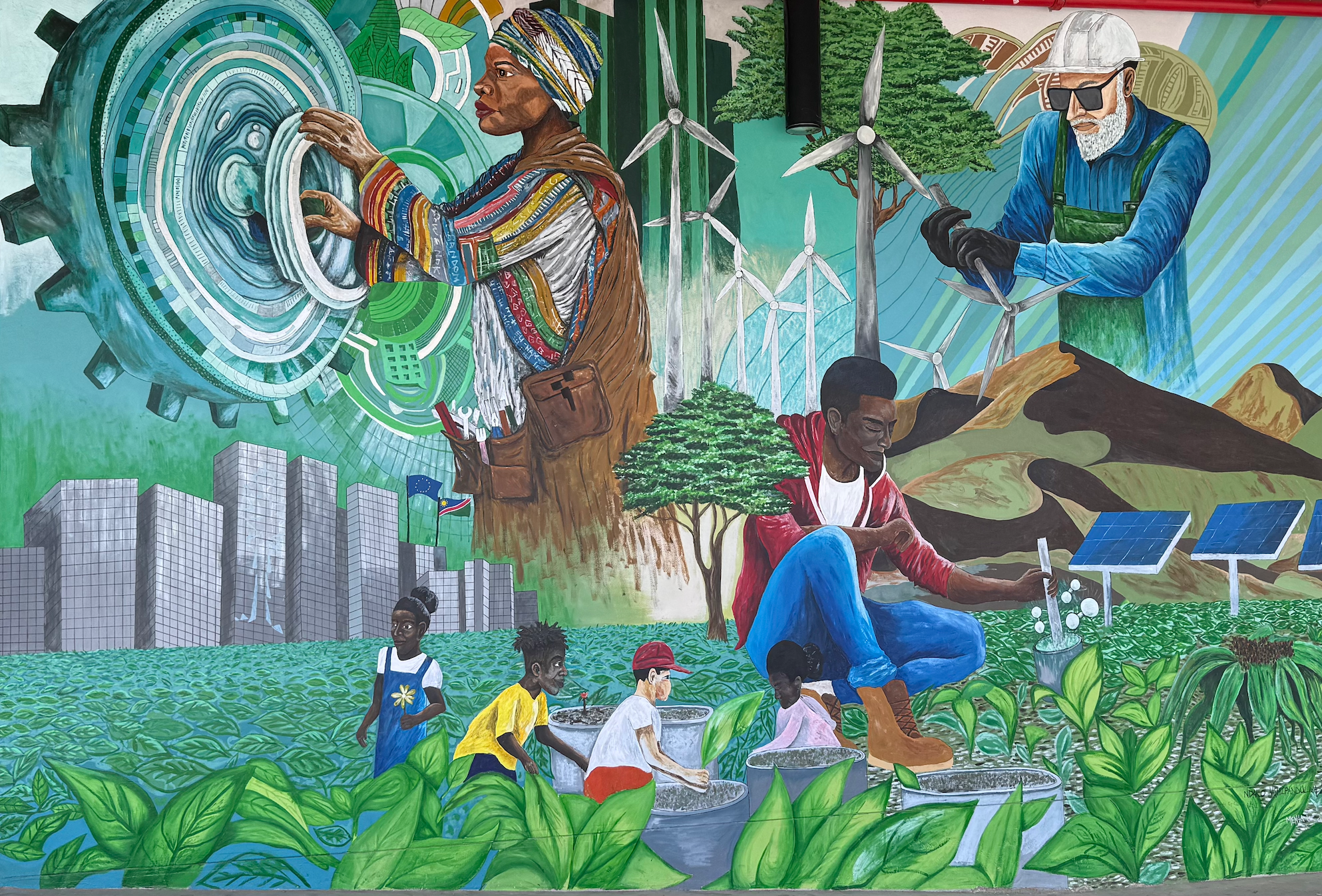
Street art on Independence Avenue, Windhoek, Namibia (photo by author)
“We are choosing to discover new lands… Today, we are leaving the fossil-fuel growth model behind us. The new lands are still blurred, but they are visible, we can reach them.”
Ursula von der Leyen
In her address to the Beyond Growth Conference in 2023, the President of the European Commission elected to describe the imperative of the energy transition through the metaphor of land. Von der Leyen’s call to discover ‘new lands’ was designed to signal a discursive break from the ‘old shores’ of carbon-fuelled growth. However, it also signalled a continuity with colonial modes of representation that view Southern territories as spaces of ‘bountiful emptiness’, full of potential for the realisation of European energy futures. Under pressure to diversify and decarbonise their energy mix in the wake of the Paris Agreement and Russia’s war in Ukraine, European states are in search of cheap ‘new lands’ for low-carbon energy generation. This search is driving a new wave of global land acquisitions, producing new spatial imaginaries and exclusions.
Within this context, green hydrogen (GH2) has gained prominence as a low-carbon energy carrier that can be transported long distances, extending the renewable energy further into postcolonial regions of the global South. Produced by splitting water into hydrogen and oxygen through a process of electrolysis powered by low-carbon electricity, green hydrogen is seen to hold the potential to decarbonise ‘hard-to-abate’ sectors of the economy, including steel, ammonia, and freight transport. It can be shipped (in the form of green ammonia) and stored in large quantities for long periods of time, providing a new spatial fix for European energy diversification and decarbonisation.
The EU has singled out the African continent as a space of ‘abundant renewables potential’ and ‘potential supplier of cost-competitive renewable hydrogen’. A series of national hydrogen strategies have been accompanied by a proliferation of investment reports and feasibility studies extolling the extraordinary green hydrogen potential of the African continent, leading analysts at Standard & Poor’s to ask whether Africa will become ‘the new green hydrogen ‘El Dorado’. In response, European states and investors have begun to remap African territories according to their ‘maximum H2 potential’, encouraging audiences of investors and policymakers to identify productive ‘hot spots’ as part of an unfolding hydrogen rush on the continent.
Producing land for hydrogen
How is land rendered available, governable and investible for the purposes of green hydrogen generation and export? What are the processes—historical and ongoing—through which ‘cheap land’ is assembled at the green hydrogen frontier? And with what implications for local communities, economies and ecologies? In a recent paper, I argue that maps play a key role within this process as knowledge-producing devices that foreground particular propositions about land—its uses, claims and values—over others. Through a critical cartographic analysis of the green hydrogen maps present within the reports of European states, lobby groups and investment bodies, I show how such maps assemble and aggregate a series of dynamic environmental processes, including wind currents and solar radiation, and fix them in space in ways that produce a new commodity: land with ‘hydrogen potential’. By remapping entire regions according to their ‘technical H2 potential’, such maps elide existing land claims, placing the burden on current owners and claimants to make the case for why a given territory should not be given over to green hydrogen production.
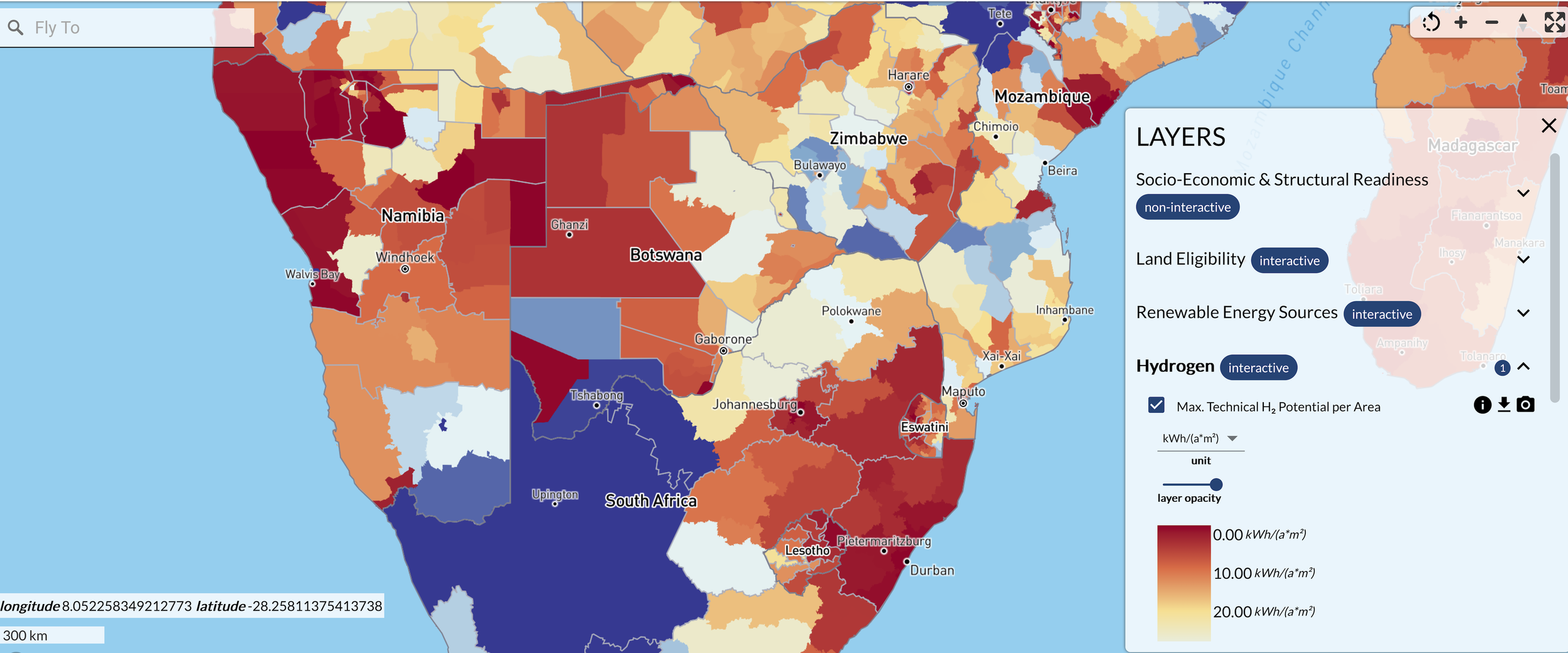
H2ATLAS-AFRICA (Reproduced from H2Atlas Africa 2024, © Institute of Energy and Climate Research, Juelich Systems Analysis, Forschungszentrum Jülich)
Following the launch of its national hydrogen strategy in 2020, the German government funded the creation of a new web-based map application, H2 ATLAS-AFRICA, which enables users to calculate the ‘technical H2 potential’ of any given area of land at the click of a mouse. The ATLAS, which bears a striking resemblance to colonial maps of the comparative value of African lands, classifies the remote ǁKaras region of Namibia as an area with among the highest ‘technical H2 potential’ and most ‘favourable’ political and regulatory environment for hydrogen production anywhere on the continent.
In 2021, Germany became the first country to formalise a hydrogen partnership with Namibia. Later that year, the Namibian government named Hyphen Hydrogen Energy, a company partly owned by the German energy multinational Enertrag, as the preferred bidder on a $9.4bn green hydrogen project in ǁKaras, one of the largest GH2 investments anywhere in the world. Following the announcement, Hyphen’s CEO emphasised the significance of Namibia’s ‘large swathes of uninhabited, government-owned land’, while the company’s website proclaimed Namibia’s ‘unique’ position as a hydrogen producer with ‘significant land availability’.
Such discourses return us to von der Leyen’s invitation for Europe to ‘discover new lands’. They form part of a broader ontology of resource productivism that categorises space by its ‘potential to be accumulated and commoditized for the ‘global good’’, cheapening land through claims to marginality and underutilisation before putting it to another use. Reproduced through cartographic products such as the H2 ATLAS, this ontology erases the role of other territorial projects, including European colonialism, resource extractivism and genocide, in the historical production of ‘new land’ for the green hydrogen frontier.
The colonial origins of the green hydrogen frontier
In the Namibian case, the land leased to the Hyphen project was fraudulently acquired by the German colonial merchant Adolf Lüderitz in 1883. The German colonial government later declared it part of the ‘Sperrgebiet’ (‘prohibited area’) in 1908 following the discovery of diamonds in the region. Between 1904-1908, the colonial regime oversaw the genocide of tens of thousands of indigenous Nama and Herero people in Namibia, including those residing in those ‘uninhabited’ areas now earmarked for green hydrogen development. This history is illustrative of how ‘new’ low-carbon energy frontiers are being assembled on the sites of historical land injustices and commodity rushes through a process that I have called ‘green refrontierisation’. In other words, the production of uninhabited spaces of ‘hydrogen potential’ on the African continent is enabled by and through historical projects of frontier-making, including those of colonial dispossession, resource extractivism, and, in the Namibian case, genocide, which conspired to depopulate and cheapen large areas of land that are now the focus of global GH2 investments.
In response, workers and communities with claims to the lands earmarked for green hydrogen development are organising to re-establish the social, political and ecological histories of the ‘new lands’ earmarked for hydrogen production. Their actions situate low-carbon energy frontiers within a longer genealogy of frontier-making on the African continent, revealing how the territories, infrastructures and imaginaries of colonial projects are reassembled at the green hydrogen frontier, shifting our focus from resource ‘discovery’ to frontier reactivation and recomposition.
- - -
Will Monteith is an interdisciplinary geographer exploring the ways in which workers in the majority world challenge taken-for-granted ideas about work and energy.