
Carbon as a question
The Carbon Working Group collectively reflects on their first in-person workshop on carbon and biodiversity governance.
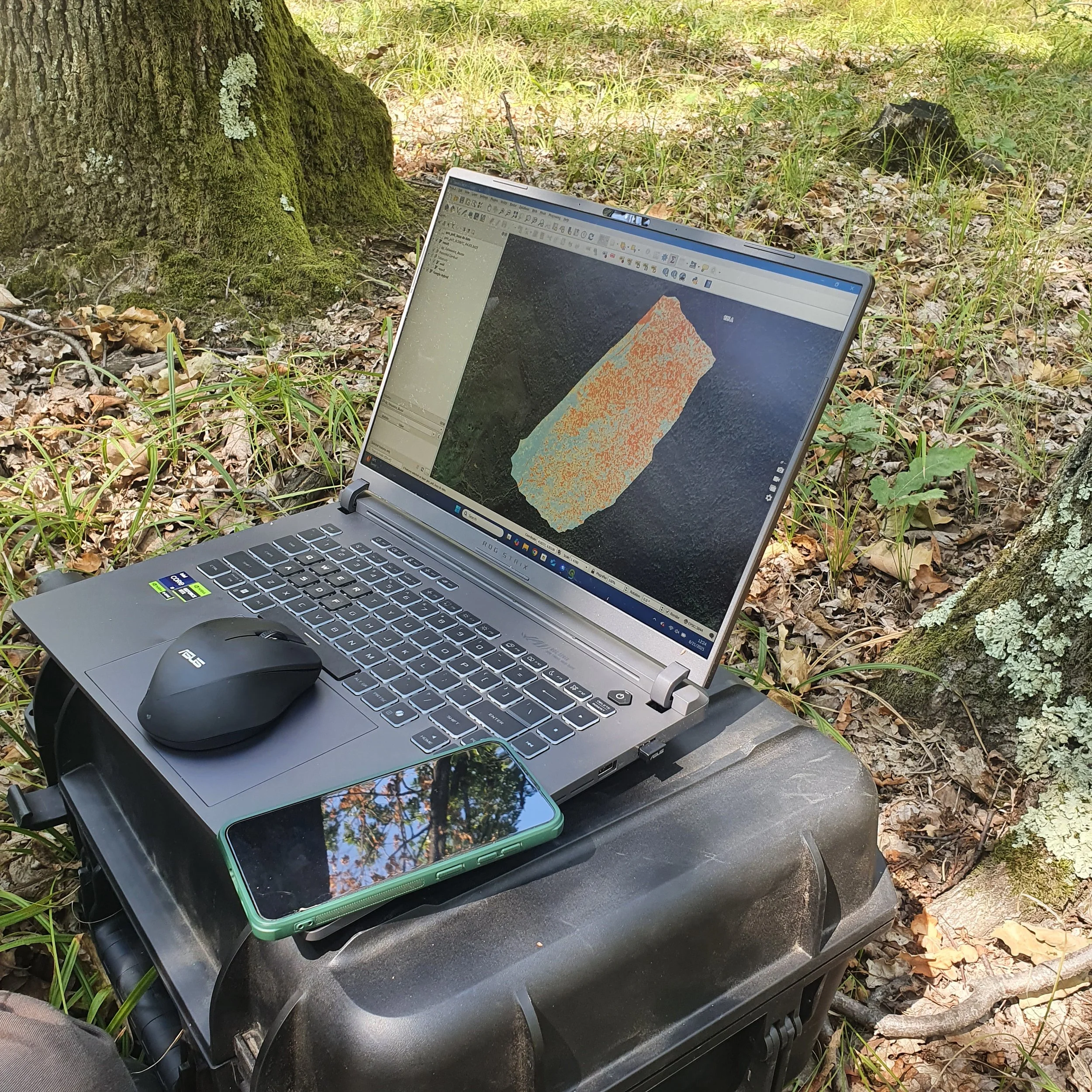
Image taken during fieldwork in a forect carbon project, 2025
What is carbon? For an element as ubiquitous and quotidian as carbon, one would expect to encounter a shared definition – at least in academic circles. As a newly established early-career research network, we used this question as a starting point for our first online meeting. Answers to this question varied and included responses such as “commons,” “promise,” and “industry strategy.” These early exchanges set the stage for our first in-person workshop, hosted by CLaSP and LSE Sociology, where we spent two days examining the past, present, and future of the socio-technical forms through which carbon emissions and absorptions are understood, governed, and commodified.
The international gathering, hosted at QMUL in April 2026, brought together early-career researchers from across Europe, including Queen Mary University of London, the London School of Economics, Goethe University Frankfurt, the Kassel Institute for Sustainability, the University of Bern, Mines Paris-PSL, and the University of Bologna. Despite our diverse reference literatures, methodological approaches and fieldwork sites, a shared concern united us: The observation that a narrowly technical and economic understanding of carbon dominates policy debates, often at the expense of plural, even contested understandings embedded in complex, power-laden, and sometimes fragile socio-ecological contexts.
Promises and Frictions Beyond the Molecule
The workshop was structured around four panels, covering topics from the social enablers of carbon dioxide removal to the production of nature-based offsets. A key cross-cutting theme emerged around the performative power of promises. Jan Gilles (LSE) explored the material and social conditions of carbon dioxide removal (CDR) by addressing the social spaces and social actors that make it possible, whereas Laure Manach (Mines Paris-PSL) analysed the ambivalence in soil science faced with the commodification of soil carbon, asking what the promises of a market actually do to scientific practices.
The tensions and interplays between the global promise of a market solution and its ground-level materialities became a central analytical axis, reflected particularly in Laura Maghețiu’s (Queen Mary University of London) contribution on the production of tree offsets in Uruguay and Romania. Felix Krawczyk (Kassel Institute for Sustainability) discussed very different promises, namely how community-based projects are challenging market-based approaches to carbon storage through an emancipatory politics. Florian Skelton (Goethe University Frankfurt), finally, offered a historical account of these promises and frictions, showing how the science, policy and market around carbon have been moving from avoiding carbon with abstract offsets to managing material flows of carbon with technical methods. Workshop participants concluded that the economy of promise and its points of contention should be held together analytically as a structural feature, rather than treating much observed market breakdowns as mere glitches in an otherwise functional system.
The Carbon Value Chain and its Sociality
A second major contribution was the collective effort to conceptualize the “carbon value chain.” Building on discussions of global production networks (GPN) and Marxist theories of circulation, participants asked where value is actually produced and how it is appropriated. Is it generated by the farmer sequestering carbon, the indigenous people preserving the forest, the scientist verifying it, the broker selling it, or the corporation offsetting its emissions?
In this perspective, Justine Leret (Goethe University Frankfurt) examined “self-made green farmers” selling credits without intermediaries, highlighting how speculative value often overshadows the material labour of carbon sequestration. Andrea Rizzi (University of Bologna) provocatively described carbon forestry as a “Trojan horse for capital and appropriation,” suggesting that these mechanisms facilitate new subtle forms of capital accumulation. When is carbon perceived as a fertile and profitable element (as in soil management) versus a negative pollutant (as in emissions)? This variability disrupts the neat commensuration required by carbon markets, which demand that diverse types of carbon and temporalities be treated as universally equivalent.
The discussion also went beyond traditional political economy by focusing on the sensory and affective dimensions of carbon. David Ilkiw (LSE) analysed for instance the “smokeworlds” born out of the Canadian wildfires and their sensory dimension, underlining the capacity of carbon to create new worlds.
Who Plans Carbon? Questions of Scale, State and Participation
Perhaps the most generative session was the collaborative brainstorming, facilitated by Kiri Santer (University of Bern) and Lisa Claussmann (Mines Paris-PSL). This discussion shifted the focus from markets to their private governance and the often-absent role of the state and civil society in the planning of some of these mechanisms. This led to a critical interrogation of scale. Some participants problematised the assumption that “scaling up” is the only viable political ambition, contrasting it with concepts of “scaling deep” and “scaling out.” As one participant summarised, scale is not just an ambition – it is a parameter that produces particular forms of politics. Here, we opened a (hopefully long-term) debate amongst us on if and how much criticized global carbon governance mechanisms can be salvaged.
This conversation also grappled with the epistemic violence of “carbon reductionism”, drawing inspiration from Bernadette Bensaude-Vincent’s concept of carbon as a “multiple being” (natural, social, and cultural). By detaching carbon from its wider social and environmental context (its ecosystem, its community, its history), policy frameworks risk creating a simplified object of governance that does not exist in reality. The key insight was that actors such as scientists, traders, farmers, and regulators are actively engaged in performing carbon as a real and manageable element. The question then becomes who gets to decide which carbon is “real,” and for whose benefit.
From debates surrounding soil carbon sequestration to the invisible industry landscapes of forestry offsets, our carbon working group workshop demonstrated that carbon is far from a stable and neutral object. Drawing from Anna Tsing, it is a point of friction through which the contested politics of our socio-environmental present and future surface. By holding together the promises, contradictions, and material realities of carbon, the CLaSP workshop established a constructive space for exchange and deep feedback that its participants are eager to cultivate through workshop formats, both online and in person.
- - -
The Carbon Working Group is a newly formed research network that brings together career researchers from various social sciences institutions across Europe to explore critical perspectives on carbon and biodiversity governance. Our research spans various mechanisms across the global decarbonization regime, including but not limited to carbon markets, carbon border adjustment, and debt-for-nature swaps. Being an interdisciplinary working group, we draw from a wide range of social sciences disciplines, including political economy, anthropology, human geography, political science, sociology and business studies.